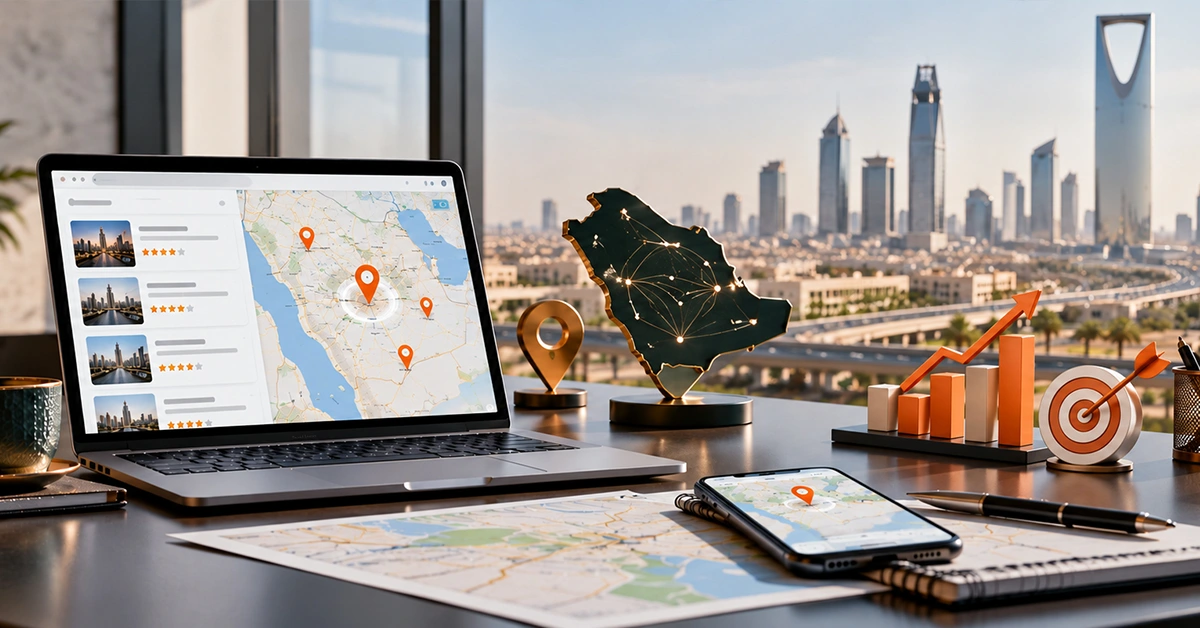
It is 9 p.m. in Riyadh, and an air conditioner has just stopped working. The owner picks up a phone, searches for help nearby, and calls the first business that looks trustworthy. That customer never scrolled to page two. If your business was not in the first few results, you never knew the sale existed.
Introduction
Saudi customers use search to decide, not just to browse. When someone types a service with a city, a district, or “near me,” they usually want to call, visit, or buy within hours. That makes high-intent local searches some of the most valuable traffic a business can earn in KSA. Ranking for them takes more than a good website. It depends on accurate business information, a well-managed Google profile, bilingual content, honest reviews, and a fast mobile experience. This guide breaks down the exact steps to optimize your local presence so you can scale your success without the stress.
Key Takeaways
Here is a quick look at the main things you will learn in this guide:
- How to recognise high-intent local searches and why they matter more than broad traffic
- How Saudi users search, and how language, mobile use, and seasons shape results
- How to set up a trustworthy business foundation, including consistent legal and contact details
- How to optimise your Google Business Profile, location pages, and reviews
- How to measure results and keep improving month after month
Table of Contents
- What High-Intent Local Searches Look Like in Saudi Arabia
- How Saudi Users Search
- Get Your Business Foundation Right
- Optimise Your Google Business Profile
- Build Location Pages That Match Local Intent
- Create Bilingual Content in Arabic and English
- Earn and Manage Reviews
- Build Local Citations and Authority
- Speed Up Your Mobile Experience and Conversion Path
- Measure Results and Keep Improving
- Final Thoughts
- FAQs
What High-Intent Local Searches Look Like in Saudi Arabia
A high-intent search shows that the person is ready to act. Compare “how does an air conditioner work,” which is someone learning, with “AC repair near me open now,” which is someone ready to call. The second type brings fewer visitors than broad searches, but far more calls, visits, and orders. Look for these signals:
- Location words: a city, district, or landmark, such as “dentist in Al Olaya”
- Proximity phrases: “near me,” “nearby”
- Urgency words: “open now,” “24 hours,” “today,” or “emergency”
- Action words: “book,” “call,” “order,” “delivery,” or “appointment”
- Comparison and price words: “best,” “price,” “offers,” or “reviews”
Build your local strategy around these phrases first, and add broader educational content later.
How Saudi Users Search
Most local searches in KSA happen on phones, often on the move. People want a phone number, a pin on the map, and opening hours within seconds, so long introductions and slow pages lose them immediately. Many also search directly in Google Maps and choose from the map results, which is why your profile often matters more than your homepage.
Language adds another layer. Users move between Arabic and English, sometimes on the same day, and district names have many spellings, such as “Al Malqa,” “Malqa,” and “الملقا.” Your content should recognise these variations naturally.
Discovery and timing also shape behaviour. Platforms such as Snapchat, TikTok, and Instagram influence which businesses people look up next, and many customers prefer to message on WhatsApp before visiting. Seasonal moments, including Ramadan, Eid, Saudi National Day, Riyadh Season, and Hajj and Umrah periods, change what people search for and when they are online. Plan your hours, offers, and content ahead of time.
Get Your Business Foundation Right
Local search rewards businesses that look real, consistent, and trustworthy. Check these basics before any optimisation:
- Legal identity: Use the same business name across your commercial registration with the Ministry of Commerce (MOCI), your ZATCA VAT records, invoices, website, and online profiles.
- Name, address, and phone consistency: Keep the same spelling and format everywhere. Adding your Saudi National Address short code to your website footer can help customers find you.
- Trust details on your website: Show your commercial registration number, VAT registration number, address, working hours, and contact details. Online stores can also display their Maroof registration.
- Clear pricing: Show prices in SAR and state whether the 15% VAT is included, for example “Inspection from SAR 150, VAT included.”
- One reliable phone number: Use a local number and, where relevant, a WhatsApp Business number. Keep both identical on every platform.
Optimise Your Google Business Profile
Google ranks local results using relevance, distance, and prominence. Your Business Profile is the best place to influence all three.
Choose the Right Category and Name
Pick the most specific primary category for your main service, and add secondary categories only for services you truly offer. Use the business name shown on your signage and licence. Adding extra descriptive words can lead to suspension.
Set Your Address, Service Areas, and Hours
Place the pin at your entrance. If you travel to customers instead of receiving them, set service areas rather than showing an address. Keep regular hours, Ramadan hours, Eid closures, and special hours updated, because wrong hours quickly damage trust. Complete verification and review these details every month.
Add Services, Photos, and Attributes
List each service with a short description and, where possible, a price in SAR. Upload real photos of the entrance, interior, team, and completed work, and add new ones every month. Mark attributes such as family seating, parking, wheelchair access, delivery, or online booking where they apply.
Use Posts, Links, and Tracking
Share new services, seasonal offers, and events through posts. Add booking, menu, and website links, and use tracking tags to see which ones bring customers.
Adapt to the End of Q&A
Google has retired the public Q&A section and is replacing it with AI-powered answers in Google Maps. Make sure your profile and website state key details, such as prices, coverage areas, and payment options, so those answers stay accurate.
Build Location Pages That Match Local Intent
A strong location page answers the searcher’s question in seconds. Create one page for each branch and each city you genuinely serve, and give each page unique content: neighbourhoods served, nearby landmarks, service details, prices, team members, and photos of your own work. Copying one page and swapping the city name adds little value and can look thin to search engines.
Put the service and city naturally in the title tag, main heading, and opening lines. Show the address, map, click-to-call button, WhatsApp button, and opening hours near the top of the page. Add LocalBusiness schema with your name, address, phone, hours, price range, and areas served so search engines understand the page clearly.
Link location pages from your menu or footer, and connect them to related service pages. Add genuine customer feedback and examples of local work, with permission, to prove that you deliver in that area.
Create Bilingual Content in Arabic and English
Serving both languages properly gives you a real advantage over competitors who offer only one.
Write Native Arabic, Not Word-for-Word Translation
Write Arabic pages for Saudi readers rather than translating line by line. Unnatural wording lowers trust, and readers notice it immediately.
Set Up Language Versions Correctly
Give each language its own URL and connect the versions with hreflang tags so Google shows the right one. Check that Arabic pages display correctly right-to-left on all phones, including buttons, forms, and numbers.
Cover Spelling Variations and Real Questions
Arabic words and district names can be written in several ways, so use natural variations in headings and body text without stuffing. Add short FAQs to key pages using questions customers ask by phone or WhatsApp, such as pricing, availability, and coverage areas.
Earn and Manage Reviews
Reviews influence both rankings and the decision to call. Build a simple routine:
- Ask at the right moment: Send a review link by WhatsApp or SMS right after a completed service.
- Make it easy: Use the direct review link from your profile and keep the steps simple.
- Respond to every review: Reply in the reviewer’s language. Thank positive reviewers by name, and answer complaints calmly with an offer to fix the issue.
- Follow the rules: Google does not allow rewarding customers for reviews. Never buy reviews, since they can be removed and can put your profile at risk.
- Encourage detail: Customers who mention the service and area give useful context for both readers and search engines.
- Keep a steady flow: A few new reviews every week look more credible than a sudden burst.
Build Local Citations and Authority
Consistent mentions across the web tell search engines your business is real and established. Start by keeping your listings on Google, Apple Maps, and Bing Places accurate and identical. Then add your business to trusted industry and city directories, checking that your name, address, and phone number match exactly. Remove or merge duplicate listings and outdated addresses, since they confuse both customers and search engines.
Authority also comes from real-world relationships. Sponsor community events, work with nearby businesses, and earn mentions from local news sites, associations, and chambers of commerce. Publish guides that local audiences want to share, such as neighbourhood service guides or seasonal checklists like “AC maintenance before summer in Riyadh.”
Speed Up Your Mobile Experience and Conversion Path
Ranking earns attention, but your site must turn it into action:
- Fast loading: Compress images, limit heavy scripts, and test pages on mobile networks.
- One-tap actions: Place call, WhatsApp, and directions buttons on every key page.
- Short forms: Ask only for essentials such as name, phone number, and preferred time.
- Local payment options: For online sales, offer familiar methods such as Mada, Apple Pay, and STC Pay, plus buy-now-pay-later options like Tabby or Tamara if they suit your customers.
- Clear delivery and service details: Explain coverage areas, delivery times, and fees in plain words.
- Trust signals: Show reviews, licence details, and guarantees near your action buttons.
Measure Results and Keep Improving
Track what matters so you can repeat what works. Local results often improve within a few months, although competitive categories in Riyadh and Jeddah can take longer. Focus on these areas:
- Profile insights: Track calls, direction requests, website clicks, and bookings from your Google profile.
- Website analytics: Set up goals for phone calls, WhatsApp clicks, form submissions, and orders, and use tagged links to separate profile traffic.
- Search Console: Review queries and pages by location to find phrases that already show your pages but earn few clicks.
- Local rank checks: Check your position from several districts. A business can rank first in Al Olaya and much lower in Al Malqa.
- Monthly routine: Review reviews, hours, photos, and competitors, then update pages and retire what does not work.
Final Thoughts
Ranking for high-intent local searches in Saudi Arabia comes down to being easy to find, easy to trust, and easy to contact. Keep your business details consistent, manage your Google profile carefully, build genuine Arabic and English pages for every place you serve, and earn honest reviews. Then remove friction so a searcher can call or visit in one tap. One final thought: start with the location that already brings you the most customers, get it right, and use it as the template for every other city.
FAQ’s
What is a high-intent local search?
It is a search where the person is close to acting, such as calling, booking, visiting, or buying. These searches usually include a location, “near me,” or words like “open now,” “price,” or “book.”
Do I need a physical shop to appear in local results?
Not always. Businesses that travel to customers can set service areas and hide their address. The business must still be real, verifiable, and honest about where it operates.
Should I create separate Arabic and English pages?
Yes. Separate pages for each language, connected with hreflang tags, help Google show the right version and give readers a natural experience.
How many reviews do I need to rank well?
There is no fixed number. A steady flow of genuine, detailed reviews and prompt replies matters more than a large one-time burst. Compare yourself with the top competitors in your area to set a realistic target.
How long does local SEO take to show results?
Many businesses see movement within two to three months, although competitive categories in large cities can take longer. Consistent updates and reviews speed things up.
Does Google Business Profile still have a Q&A section?
No. Google has retired it and is replacing it with AI-powered answers in Google Maps. Keep your profile and website details complete and accurate so those answers reflect your business correctly.
Read More
- How to Build a Google Business Profile That Drives Calls and Visits
- How to Optimise a Bilingual Arabic and English Website for Search
- A Simple Guide to Getting More Google Reviews Without Breaking the Rules
Keep following us for more guides and updates.